
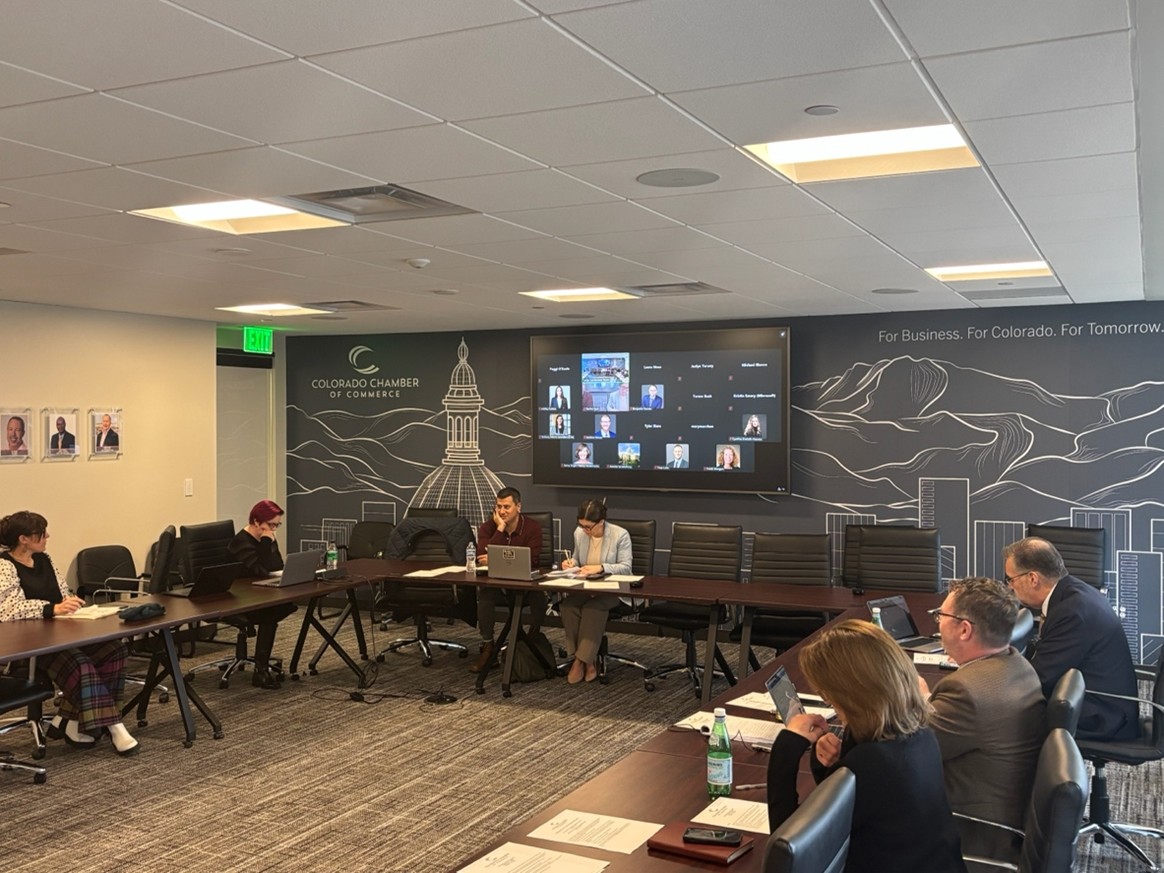
This week, the Colorado Chamber Energy & Environment Council, Tech Alliance and Legal Reform Alliance met to take positions on introduced bills and share legislative updates.
The Energy and Environment Council discussed proposed regulatory requirements and changes to permitting processes. Members of the Chamber’s Legal Reform Alliance discussed constitutional concerns with proposed changes to the judicial system and the role of private equity in the legal sector. The Tech Alliance tackled a full agenda of introduced legislation, including proposed changes to how certain types of data are used, increased social media protections and requirements for how companies interact with law enforcement agencies.
Energy & Environment Positions:
HB 1112: Amend
This proposal would grant rulemaking authority to state agencies to oversee certain underground injection well classes. Class I, IV, and V injection wells would fall under the Energy and Carbon Management Commission, while the Mined Land Reclamation Board would have authority of class III injection wells. The Chamber took an “amend” position on the bill to clarify what constitutes a violation and address the expanded liability for employers.
HB 1121: Oppose
The bill requires an operator of a building that reports emissions to state or federal agencies to also publish the same records on the operator’s public website. In most cases, the records must be submitted on the same schedule required by state or federal agencies. The Chamber opposed the bill because it duplicates existing reporting requirements and shifts the burden of transparency onto private companies, rather than the state.
SB 065: Oppose
The legislation would prohibit the sale of seeds treated with certain products unless a buyer receives a third-party verification authorizing the sale. The Chamber is opposed to the bill due to its unrealistic inspection requirements and the burdensome third-party verification process.
SB 102: Oppose
The bill creates extensive requirements for both data centers with a certain peak load of electricity and for utilities servicing them. The bill would take effect over 4 years, with the final stages requiring data centers to offset 100% of electricity used with renewable sources. The Chamber is opposed to the bill due to member’s concerns with the unrealistic renewable energy matching requirements and implications for Colorado’s competitiveness.
Tech Alliance Positions:
HB 1037: Amend
The bill prohibits law enforcement and other government entities from purchasing certain personal data from third parties or sharing personal data between agencies. Certain exceptions exist for warrants or emergency circumstances. The Colorado Chamber Tech Alliance took an “amend” position to further clarify definitions.
HB 1148: Oppose
This legislation creates requirements related to the usage of social media by minors. It sets extensive requirements for privacy settings, data retention practices, notification settings and disclosure of algorithms. It also creates a fee to be collected for each add-on transaction through an online gaming service. The Chamber voted to oppose the bill due to concerns with the transaction fee and the vague definitions in the bill.
HB 1210: Oppose
This bill would prohibit the use of certain types of digital data to set prices or wages for consumers or workers. The Chamber opposed the legislation because it is overly broad and could prevent businesses from offering customers discounts or loyalty incentives, reducing available savings and potentially increasing costs for consumers.
HB 1211: Oppose
The bill would authorize the Public Utilities Commission to regulate broadband and voice-over-internet protocol services and adopt quality and safety rules. It would also require the commission to perform routine evaluations of broadband infrastructure and annually report on findings to the General Assembly. The Colorado Chamber’s Tech Alliance opposed the bill due to concerns that the commission is not the proper regulatory agency to manage the broadband industry.
SB 011: Amend
This proposal would require certain online services to establish a streamlined process for a law enforcement agency to contact the platform, including a staffed hotline, mandated response requirements and routine status updates on search warrant compliance.
SB 051: Amend
This legislation requires an operating system provider to develop certain systems that share a user’s age information with application developers. It also requires a developer to request the age information after the application is downloaded and launched. The Chamber took an “amend” position to ensure that the legislation does not create unintended consequences.
SB 070: Oppose
The bill prohibits a government entity from accessing a database concerning a person or a vehicle’s location data or sharing location data with third parties or other government agencies. Certain exemptions exist if a government entity adopts a policy complying with the regulations in the bill. The Colorado Chamber is opposed to the bill due to public safety concerns.
SB 102: Oppose
This legislation creates extensive requirements for both data centers with a certain peak load of electricity and for utilities servicing them. The bill would take effect over 4 years, with the final stages requiring data centers to offset 100% of electricity used with renewable sources. The Chamber’s Tech Alliance is opposed to the bill due to concerns with the hourly matching requirements and the likelihood that data centers would not consider Colorado for development, impacting the state’s competitiveness.